

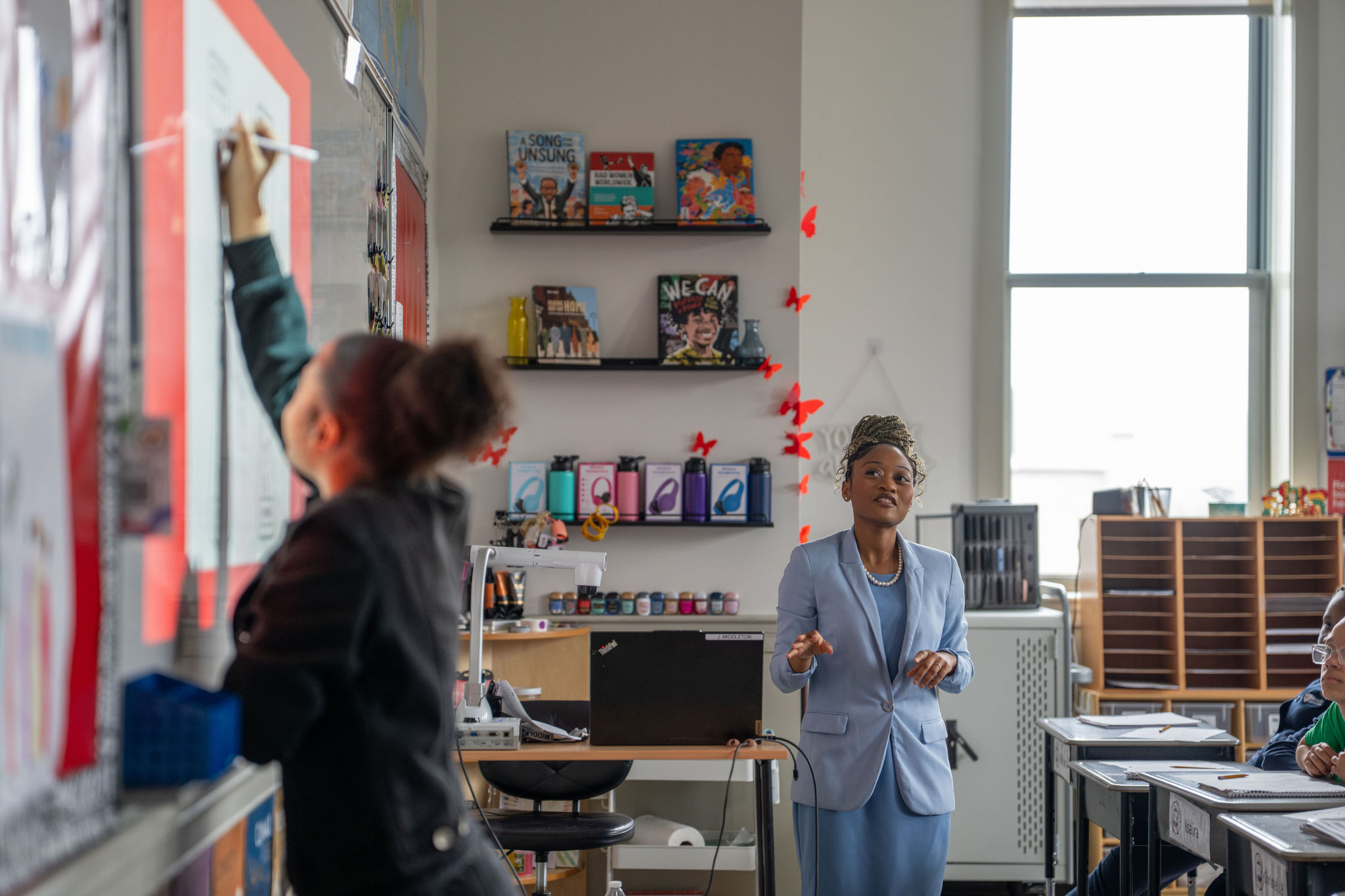
Stepping In, Stepping Up: Jordyn Middleton’s Journey as a Brooke Associate Teacher

In her first year at Brooke, Associate Teacher Jordyn Middleton has taken on the challenge of stepping into classrooms across grade levels and subject areas – from elementary classrooms to sixth-grade math and science.
Along the way, she has grown as an educator, built meaningful relationships with students, and embraced every opportunity to learn. In this conversation, Jordyn reflects on her experience in the Associate Teacher Program, the lessons she’s learned through coverage, and what continues to inspire her in the classroom.
What made you interested in applying to Brooke’s Associate Teacher Program specifically?
I aligned with Brooke’s mission to close the achievement gap in Boston and beyond. I want to empower and uplift students, especially students of color, because I had mentors who poured into me. I wanted to come back and make sure students have not only academic support, but personal support, to reach their highest dreams and become change makers.
How would you describe your experience in the Associate Teacher Program so far?
My experience in the Associate Teacher Program has been an opportunity for growth and professional development as an educator. As a first-year teacher, I’ve been intentional about taking advantage of PD experiences and thinking about how to maximize classroom culture and support different learning modalities.
What has surprised you the most about working as an Associate Teacher?
You may have a plan, but it’s okay to pivot and know that the pivot can be good even if it wasn’t how you envisioned it first. You may go in a day thinking I should run my lesson this way, and trying different things has helped me explore how to reach my students so they see themselves represented and are able to have fun with their learning process. That really takes a lot of problem solving.
What skills have you developed this year that you feel most proud of?
I’m truly proud of my classroom management. I think when you’re a new teacher, it’s a little nerve-racking going into a classroom and managing it on your own, but I’ve really been able to think about how to incorporate turns and talks and scaffold my students’ learning process. I’m also big on joy – embodying joy in my classroom and making sure it’s a safe space for students to feel excited to learn. My one mission is to make sure that students enjoy learning.
How has coaching and feedback shaped your growth as an educator?
Earlier in my associate teacher process, I did a lot of 1:1 mentoring with the Director of the Associate Teacher Program, Dr. Stacker. She really took the time to teach us a lot about different ways to show up as an AT, how to be able to manage your classroom the day of, how to think about your tone and your radar, etc.
My mentor, Anna Cataldo, really took the time to sit down with me and think about, “okay, here’s a video of you teaching, what’s one thing you really found that you were strong in, what is one thing that you can change or grow in?”, and so I think feedback for me was just an opportunity to have a growth mindset. It’s never really bad to get feedback, it’s just really an opportunity for you to grow. And always ask questions if there’s something you’re unclear about. You’re constantly growing and learning to become a better educator.
What have you learned from covering classrooms?
I have learned to be adaptable. A lot of times you’ll be in situations where you may know a lesson plan front to back and other times where you know absolutely nothing, and that’s okay.
I would prioritize thinking about what you can do to make sure you’re managing the class, rather than knowing the entire lesson overall. If you can manage your classroom and everything feels safe, the students feel safe and comfortable. You have to be very intentional about calls and responses, how to get their attention, what they are interested in, and how to connect.
What’s both challenging and rewarding about doing coverage?
The challenging thing is sometimes you may get a call or text at 6 AM and you don’t know what you’re stepping into. That can feel nerve-wracking.
But the reward is getting to know the kids. Our scholars are so amazing, and they teach me so much about the beauty of life. Just as much as you’re teaching them, you’re also learning from them.
So I think just getting to know them and your colleagues is the most beautiful part.
What was the transition like moving from covering sixth-grade math to sixth-grade science?
The transition was very quick. I appreciated getting to work closely with our department chairs, who helped me understand the curriculum. I didn’t have a background in math or science, so I had to be intentional about constantly learning. The more you know, the more you’re able to deposit into your students. I was using my planning periods to think of everything in a way that is understandable for them.
It pushed me out of my comfort zone, which I really valued because I was learning with my scholars. They don’t always see the behind the scenes, but it feels good to know like, hey, I’m actually learning this with you, so you’re not alone.
How has the Brooke community supported you?
My sixth grade team has been a joy to work with, and I’ve learned so much from them. My AP, Ms. Wallace, has also helped me think about my long-term career goals. Across the network, teachers have really poured into me, and I appreciate that.
New Teacher Orientation and Training in July prepared me for my transition into Brooke, and I’m grateful to the network team for grounding us in the mission and history. I also appreciated the intentional networking events that helped me build relationships when I first moved to Boston.
Being part of Brooke’s Diversity Initiative Group allowed me to connect with educators of color across the network and see their impact. Overall, Brooke has helped me grow into a well-rounded educator who ensures students feel both challenged and known.
What advice would you give to someone considering applying to the Associate Teacher Program?
The biggest piece of advice is to be intentional about your learning experience. Every opportunity for coverage or to shadow another teacher is really an opportunity for you to think about what you want to incorporate in your pedagogy.
You can take what feels good for you and leave what doesn’t. But every day is an opportunity for you to not only sow seeds, but for you to learn. And the more you take from it, the more you’re able to grow into the educator that you want to be.