

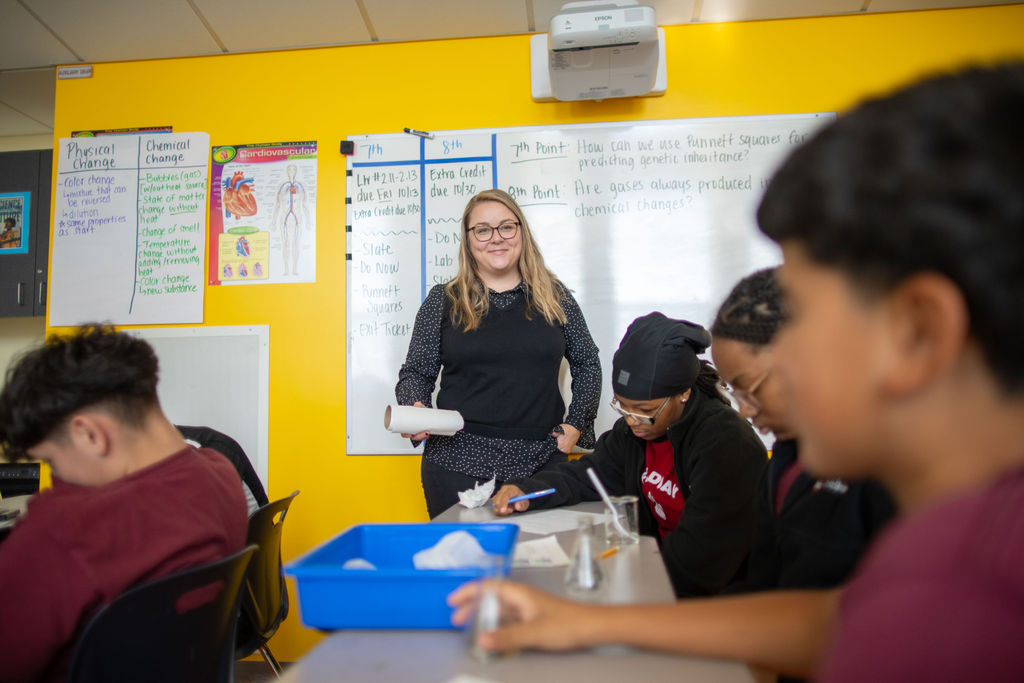
Leading Through Community: Kim Hinkey’s Path from Teacher to AP

When Kim Hinkey joined Brooke in 2019 as a sixth and seventh grade science teacher at Brooke East Boston, she was drawn to the joy she saw in classrooms, the strong sense of community, and the school’s commitment to hands-on, student-centered learning.
Over the past seven years, Kim has grown from a middle school science teacher into an Assistant Principal at Brooke East Boston. Through experiences like Leadership 101 and Communities of Practice, she developed a deeper understanding of what impactful leadership looks like at Brooke.
In this conversation, Kim reflects on her journey into leadership, the lessons that shaped her, and the importance of cultivating strong communities within schools.
What qualities do you think make someone an impactful leader here at Brooke?
First off, you just have to care deeply about the learning of kids and be really bought into the vision. We talk about building great teachers and putting the thinking on kids. Truly caring about kids learning and excelling in everything they do has to be foundational.
The second thing is collaboration. You have to be someone who is good at collaborating or open to collaborating because you’re going to work with a lot of different people who have different styles. I think that’s wonderful about Brooke.
I also think leaders have to be really open to feedback. As a teacher, you get a lot of positive feedback from kids and colleagues. In leadership, you’re behind the scenes trying to create joy for teachers and students, but you’re also getting feedback from teachers, students, parents – from a lot of avenues and at a much more intense frequency. Being open to feedback, digesting it, moving forward with it, and also creating clear boundaries is important.
How do you think great teaching contributes beyond teaching into leadership?
I came the year before the pandemic, and at that point it felt like we had a really strong community of practice where teachers were learning from each other, being in each other’s classrooms, and supporting one another. Great teaching came from a strong community.
Then the pandemic happened, and it became really hard to maintain that sense of community. Now I feel like we’re getting back to asking, “How are we a community again?” We’ve done things like Harvesting Excellence and watched videos in PD that help build that community back up.
Alongside that, we’ve also really pushed the data piece. Great teaching means you’re bought into being part of the community, but you’re also owning your own data and the data of the community.
Those ideas extend beyond the classroom. I think it helps kids build goals for themselves, and we’ve created such a strong community that students who leave and go to another high school or college still come back. They come back because they feel connected.
What are some things you learned as a teacher that have been helpful for you as a leader?
My first year as an assistant principal, I really wanted everyone to be happy and stress-free, which just isn’t possible. There are always things that pop up. Reflecting on my team as a teacher, I realized that if I just tried to please people or do everything for everyone, we wouldn’t get anything done. Learning how to create healthy boundaries and communicate clearly was foundational for the role I’m in now.
I also learned how important autonomy is. Elza gave our team a lot of autonomy, which schools I had been at before didn’t do. We created schedules for field days, designed initiatives, and solved problems ourselves. That really strengthened my problem-solving skills, and now I try to carry that same autonomy into the work I do as a leader.
Thinking about Leadership 101, how did that program challenge or expand your understanding of what leadership looks like at Brooke?
We read a couple of different books, and the one I loved most was Switch, which focused on habits and routines. Going from being a teacher to an AP is tricky, and that book was really helpful.
One thing that pushed me was realizing that difficult conversations are inevitable. We spent a lot of time talking about how to navigate them and how to repair relationships afterward.
We also did a case study, which was probably my favorite part. They gave us a fictional school scenario with teacher profiles and surveys, and we had to think through how we’d come in as a first-year AP, shift the vision, and get people bought in.
What was hard was realizing you can’t fix everything. You have to prioritize. That project felt really transferable to my first year as an AP because it made me think critically about what matters most and how to balance competing priorities.
What surprised you most about instructional leadership after participating in Leadership 101?
One thing that surprised me was conversations around “staying on the bus or getting off the bus.” We talked about when someone might not be the best fit for the community anymore.
I think my instinct is always to give people another chance because of the human empathy piece. However, we talked about how one person’s mindset or energy can have a ripple effect on the entire community really shifted my thinking.
What leadership skills do you think you’ve developed the most as an AP?
Honestly, I’ve fallen in love with spreadsheets. I’ve really leaned into the data side of leadership.
As a teacher, I looked at my own classroom data. Now I’m thinking about whole-school data and how to help teachers backwards plan from it. I’ve also worked a lot on RTI (Response to Intervention) and figuring out how to identify foundational gaps students are missing and strategically support them.
We also have our Communities of Practice, which focused on real situations we were facing. Last year especially, we focused a lot on vision setting – what’s your vision for your team and what do you want to prioritize?
This year we built more on coaching systems, conferencing, and data collection. We talked a lot about differentiating coaching plans for teachers and being transparent about where teachers are in their development trajectory.
Why do you think programs like Leadership 101 matter for educator development and retention?
Leadership 101 is important because there are a lot of teachers who are curious about leadership but aren’t ready to fully jump in yet. It creates a stepping stone.
You get to hear different leadership perspectives, understand why Brooke makes certain decisions, and gain transparency into all the different components of school leadership.
At the same time, even teachers who don’t become school leaders can still take what they learn and apply it in their classrooms – building stronger communities, strengthening culture, and thinking more strategically.