

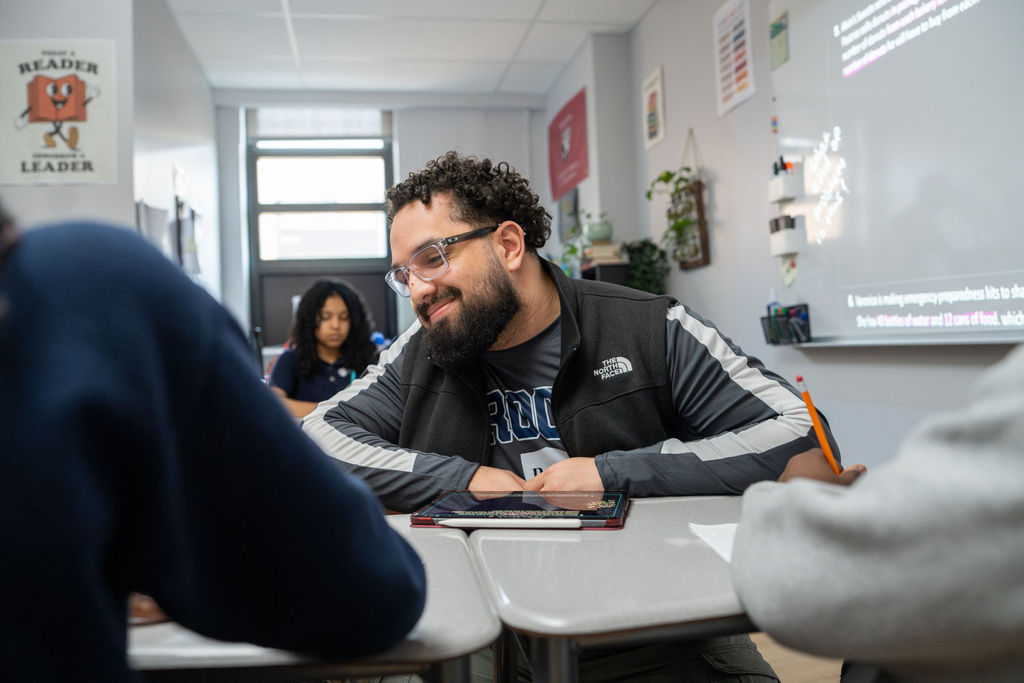
From Brooke Student to Brooke Teacher: Mr. Andys Gonzalez

A member of Brooke Roslindale’s Class of 2013, Mr. Gonzalez returned to Brooke in 2021 as a School Culture Aide before becoming the school’s first Operations Coordinator and later transitioning into his current role as a Student Support Teacher in 2023.
Now, he supports our scholars as a Student Support Teacher in the very halls where he once sat as a student himself. In this conversation, Mr. Gonzalez reflects on his journey from Brooke student to educator, the mentors who shaped him, and the impact of helping students feel both challenged and deeply known.
What does it feel like to walk the halls of Brooke Roslindale now as a staff member after graduating from here in 2013?
It’s a full-circle moment because I used to sit in some of the classrooms that I now work in. I’m mostly grateful because I was educated here, and I attribute so much of my personal and academic growth to this community and to my teachers, past and present. So to be able to give back to the school that gave me so much means the world to me.
When you think back to your time as a Brooke Roslindale student, is there one memory that still sticks with you?
Yeah, there are a lot. There are a few special memories – from the community meetings with Jon Clark to schoolwide competitions. I remember being selected to be my class’s commencement speaker and giving a speech to my classmates at the end of the year. It was an honor to be selected and share a few words with everyone.
How does being a Brooke alum shape the way you support students today?
You can call me old-fashioned – I just come from a different era of Brooke. The way the school runs now isn’t necessarily how it was run 15 years ago, and that’s not a bad thing. Our core essence, who we are, still remains the same.
I think all students here are challenged and known, and honestly more so now than even in my time. We celebrate not only academic success like MCAS, honor roll, and Reader Leaders, but we also celebrate our roots, our communities, our similarities, and our differences.
Being an alum gives me a unique perspective of what life is like after Brooke. A lot of the life conversations I have with students are like, “This is where you are now, and this is where you could be in the future.” I can give feedback and advice because I’ve done this before, and now I work here.
What drew you to working in student support and special education?
I didn’t do a lot of career planning during my last year of college, partly because it coincided with the first year of the pandemic.
I had been looking for jobs and saw that Brooke had an opening for a school culture aide position. I reached out to Ms. Parquette, and that led to me becoming the school’s first operations coordinator.
At one point, I thought my time here was up because my ultimate goal is to attend law school and become a lawyer. But, a math student support position opened up last minute, and I took it. I haven’t looked back since! I really enjoy the small-group work and mentoring students. Honestly, I think they teach me more about life and about myself than I teach them, and I think that’s the point.
How do you help ensure that students with different learning needs feel supported and successful in the classroom?
It takes a lot of preparation behind the scenes. First, you have to know what you’re teaching and understand students’ profiles – where they’re coming from academically and personally. That requires communication with families and constant communication with teachers so that everyone is aligned.
The plan going into class every day has to be consistent and rigorous. Even if a student is taking a baby step, that step still matters. A lot of students want to learn and grow, so it’s about building off of that while being supportive and challenging at the same time.
How do you help students advocate for themselves and their needs?
Academically, if a student is unhappy with their grades, we talk about where they think they’re falling short and where they think teachers or support staff could improve too. It helps build self-reflection.
One thing I have really focused on is annotation, highlighting important information so students can better access a problem instead of feeling lost immediately. A lot of kids weren’t annotating before, but now many of them are, and they’re entering problems on much stronger footing.
For personal relationships, with friends or teachers, we use restorative conversations. We ask questions like: “What happened? How did you feel? How do you think the other person felt? What could have been done differently?”
It helps students build the skills to navigate difficult conversations in the future.
You won an award this past year. What did that recognition mean for you?
It was very validating to be recognized. I had also received an SGP award after my first year of teaching, so it reminded me that people notice the work.
The kids talk to other adults about me, and my colleagues see what I do and how I do it. So it was gratifying and validating to know that the work I’m doing matters.
You’ve referred a lot of people to work at Brooke over the years. What keeps you encouraging others to join this community?
Brooke is a great place to work because there are so many opportunities across different campuses and roles. When I meet people who are mission-aligned and interested in working with students, I recommend Brooke because I’ve seen how much support and development people receive here.
One thing that really stands out is that people at Brooke genuinely invest in each other’s growth. Whether it’s school leaders, administrators, or your colleagues, there’s a strong culture of continuous learning and professional development. People here are always striving to improve themselves and help others improve too.
At Brooke, there’s really no room to stay stagnant. You’re constantly surrounded by people who challenge you, support you, and push you to grow.